Portland’s Economy in 2020 vs. 2025: A Tale of Two Recoveries
Portland entered 2020 as a growing, regionally competitive metro with strong household demand, a diversified employment base, and a population still increasing at a steady, if slowing, pace. Five years later, the story looks markedly different. The period between 2020 and 2025 reshaped the trajectory of the Portland metro economy, exposing structural weaknesses that were not fully visible before the pandemic and amplifying long‑term pressures in housing, population growth, and business competitiveness.
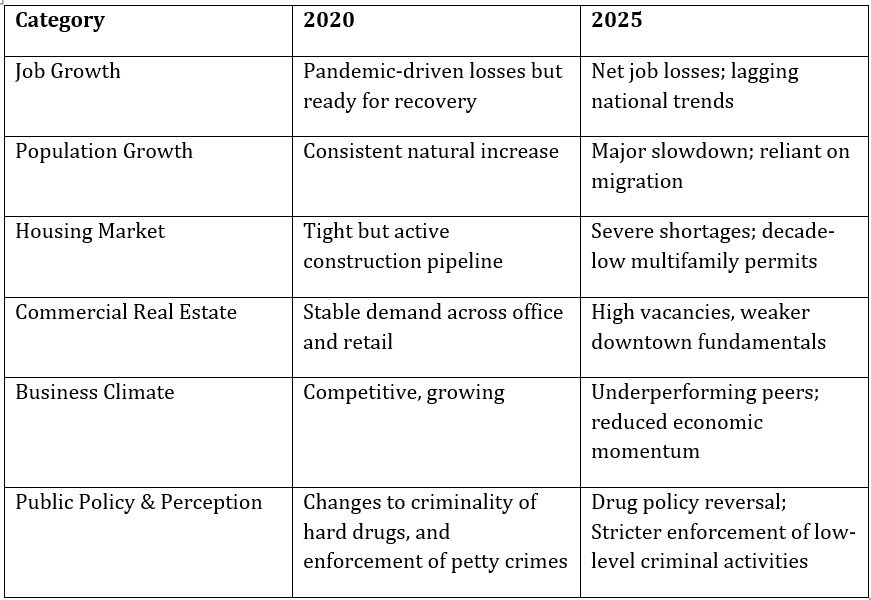
Below is a clear, data‑backed comparison of where Portland stood in 2020 and what changed by 2025, and what those differences say about the region’s future.
1. Jobs & Employment: From Crisis Shock to Structural Weakness
2020: A Pandemic-Driven Contraction, Not a Structural Decline
When 2020 began, Portland’s job market was healthy and in line with national trends. Unemployment was low, hiring was steady, and sectors like professional services, manufacturing, and technology were contributing to stable growth.
Of course, the pandemic changed everything. Hospitality, retail, tourism, and personal services were hit hardest, and office‑driven employment paused abruptly. But the key detail is this:
Portland’s job losses in 2020 were largely pandemic-related, not local-economy-specific.
The region entered the crisis from a position of relative strength, with expectations of a solid rebound once public-health restrictions eased.
2025: A Job Market Falling Behind the Nation
By 2025, that rebound never fully materialized. The Portland metro ended up with roughly 8,800 fewer jobs than before, making it one of the weaker-performing major metros in the country. Employment declines were spread across multiple sectors, including construction, professional services, information, and manufacturing, indicating broad underlying fragility rather than a single troubled industry.
The biggest difference between the two years is this:
In 2020, the downturn was temporary and externally driven. In 2025, the weakness was structural and out of step with national growth.
2. Population Growth: From Gradual Expansion to Stagnation
2020: Slow but Sustainable Growth
Portland’s growth rate had softened compared to the mid‑2010s, but the region still saw consistent gains driven primarily by natural increase (more births than deaths) and steady in‑migration. Even with affordability concerns rising, the metro remained an appealing destination for households seeking quality of life, proximity to nature, and access to employment centers.
2025: Sharp Slowdown and a New Dependence on Migration
By 2025, the region’s population dynamics had shifted. Natural population growth slowed dramatically as births declined and deaths increased, reflecting aging demographics, lower birth rates, and broader national trends.
Portland’s growth became increasingly dependent on international in‑migration, and even that was not enough to offset slowing household formation. In essence:
• 2020 population growth was modest but reliable.
• 2025 population growth was minimal and far less self-sustaining.
A slower-growing population has real economic consequences: less consumer demand, fewer new households, and a smaller labor force pipeline.
3. Housing & Real Estate: From Tight Market to Constrained Pipeline
2020: High Demand and Strong Construction Momentum
Portland entered 2020 with:
• strong demand for rentals and for-sale housing,
• a severe affordability problem,
• and robust construction activity, particularly in multifamily development.
Developers were still building aggressively, and although costs were rising, the pipeline was active.
2025: A Decade-Low in New Multifamily Permits
By 2025, the housing story changed significantly. Multifamily permits fell to their lowest level in more than ten years, a major concern for a region already struggling with affordability. Rising construction costs, interest-rate pressure, and challenging project financing conditions all contributed to fewer starts.
At the same time:
• rents remained high,
• supply remained constrained,
• and affordability worsened.
The commercial market also reflected deeper economic issues. Downtown Portland faced record-high office vacancy, driven by remote work, tenant downsizing, and shifting perceptions of the urban core.
The contrast is stark:
2020’s challenge was affordability; 2025’s challenge is affordability and a shrinking pipeline.
4. Business Environment & Economic Momentum
2020: A Competitive Regional Player
In 2020, Portland still enjoyed a reputation as a vibrant, innovative metro with strengths in:
• trade and logistics,
• athletic and outdoor brands,
• advanced manufacturing,
• creative industries,
• and technology.
The region’s business climate wasn’t perfect, regulatory and cost pressures were real, but Portland was still firmly in the conversation among dynamic West Coast markets.
2025: A Reputation Slide and Slower Momentum
By 2025, local and national reports increasingly described Portland as struggling relative to peer cities. Several trends contributed:
• reduced corporate investment,
• pullbacks by major employers,
• weaker downtown retail and office demand,
• slower export activity,
• and competitiveness slipping compared to metros such as Seattle, Salt Lake City, and Denver.
This does not mean Portland lacks long-term strengths, but in 2025, the near-term business narrative is more cautious than optimistic.
5. Overall Economic Health: From Pandemic Recovery to Structural Challenge
2020: A Region Hit Hard but Still Resilient
Portland’s position in 2020 was not ideal, but it was understandable given global circumstances:
• Job losses were pandemic-related.
• The economy aligned with national patterns.
• Housing demand was strong.
• Population growth, while softening, was intact.
The expectation at the time was that recovery would reignite growth.
2025: A Convergence of Slowing Indicators
Instead, by 2025 Portland found itself managing:
• net job losses,
• minimal population growth,
• declining housing construction,
• high commercial vacancies,
• and weakened business momentum.
Local economists even described conditions as bordering on a “near crisis” in certain sectors, particularly housing supply and labor force growth.
6. Public Policy Changes & Regional Perception
2020: A Region Hit Hard but Still Resilient
In 2020 and shortly thereafter, several policy decisions and enforcement challenges began reshaping how Portland was viewed by residents and by people considering relocation. Key factors included:
• Measure 110’s decriminalization of small‑amount hard drug possession.
• Legal and enforcement limits that reduced the city’s ability to manage public camping.
• Rising public concern about retail theft and inconsistent enforcement.
Together, these shifts quickly influenced perceptions of safety, order and overall livability.
2025: Policy Reversals, Renewed Enforcement, and Reputation Impacts
By 2025, Portland was navigating the effects of several major policy shifts:
• Hard drug possession was recriminalized in late 2024, reversing Measure 110.
• The city adopted clearer public‑camping rules and restarted enforcement in late 2025.
• Perceptions of limited consequences for retail theft continued despite existing penalties.
These shifts and the years of highly visible disorder that followed had a dampening effect on both local confidence and national interest in the region, now reversing as enforcement efforts are moving back toward stricter norms and the recriminalization of hard drugs.
What This Means for Portland’s Future
The comparison between 2020 and 2025 reveals a regional economy that began the decade with strength but encountered deeper challenges than most U.S. metros in the years that followed. Many of the issues Portland faces today, housing affordability, urban vitality, job competitiveness, and population stagnation, are solvable, but they require coordinated policy, investment, and long-term focus.
Livability will also improve as the region makes steady progress on core essentials like public safety, clean neighborhoods, and reliable services. Strengthening these foundations can help restore confidence for residents and employers alike, supporting a more vibrant and resilient economy. With coordinated leadership and continued investment in community well‑being, Portland has a clear path to rebuilding momentum.
The silver lining: the region still has the core assets that made it attractive in the first place, including a skilled workforce, access to global trade routes, a strong higher‑education ecosystem, and nationally recognized quality of life. The question for the next five years will be how effectively Portland can translate those strengths into renewed economic confidence and structural recovery.